

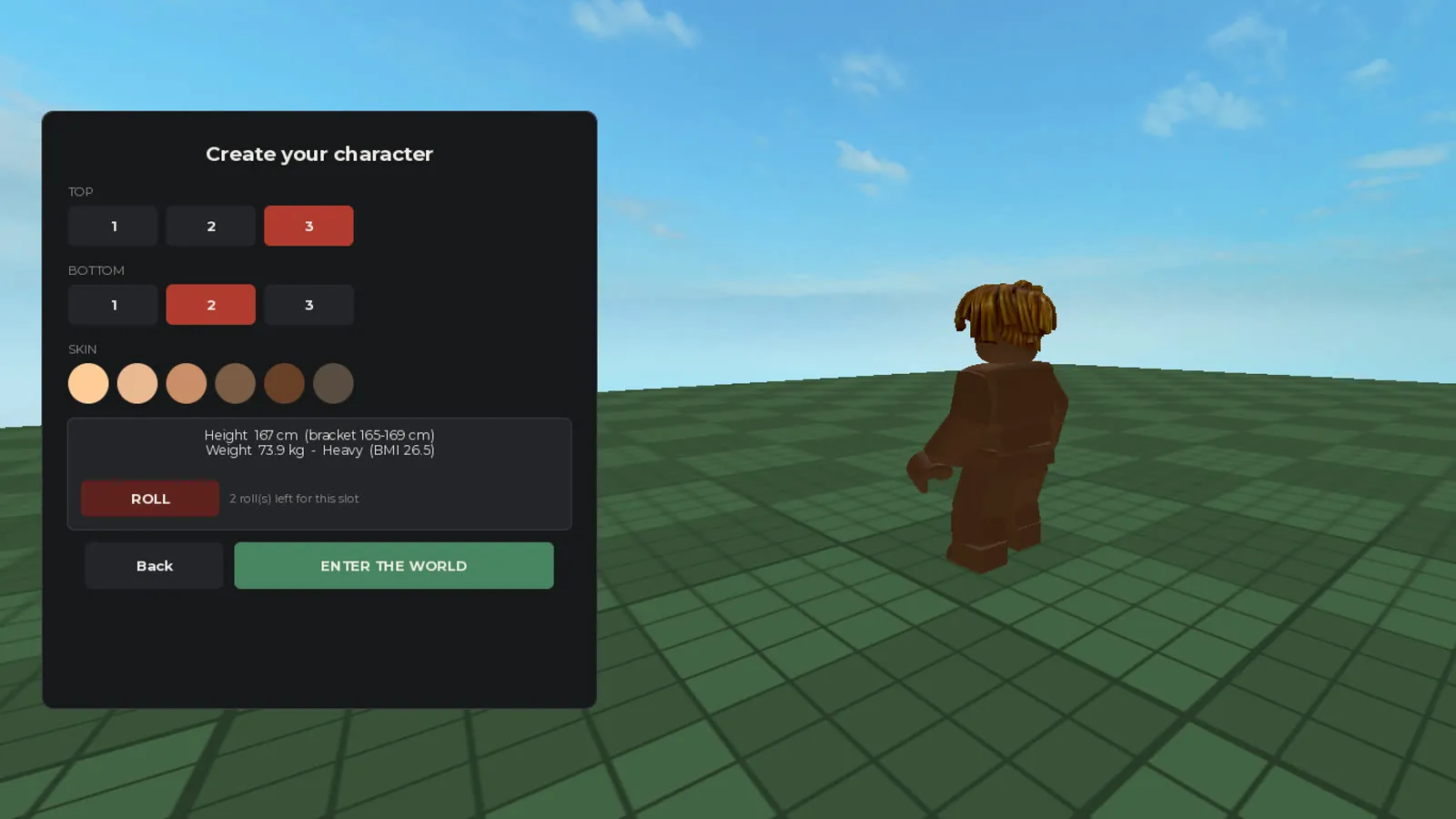
R6 character creation — weighted rolls, manual rig scaling, session-locked saves
What it is
Main menu → mode → slot → character creation → play, with the character restored on rejoin. Height and weight are rolled server-side against probability tables from the client's design doc, an R6 rig is resized by hand (the engine's scale values are R15-only), and profiles persist through a session-locked DataStore layer. Studio trial; 400,000-roll distribution test runs outside Roblox.
Under the hood
My role: sole author — menu flow, server authority, persistence, rig scaling and the test harness. Built as a trial for a survival-horror studio; their clothing asset IDs and design PDF are theirs and are not in this write-up.
The flow is four screens on the client and zero decisions on the client. Every roll, every confirm, every slot selection is a request; CharacterService on the server owns the roll budget, the whitelist of allowed assets, and the profile. Height and weight come from a weighted table — a bell curve centred on 170 cm and BMI stages from the studio’s document — and tests/distribution_check.lua runs 400,000 rolls through the real RollTables module outside Roblox (luau tests/distribution_check.lua) and checks 53 assertions against the intended distribution, so “the odds are right” is a test result, not a claim.
The hard problem was the rig. The usual way to resize a Roblox character is Humanoid.BodyHeightScale / BodyWidthScale / BodyDepthScale — and those are R15-only. On an R6 rig the failure is silent: creating the NumberValues throws nothing, logs nothing, and the avatar stays exactly average while the menu says 220 cm. Since the brief specified R6, R6Scaler does it by hand: resize each part, rescale the Motor6D C0/C1 offsets (or limbs detach), rescale Attachment positions (or hats float where the old head was), rescale the head mesh, and correct HipHeight using the R6 formula, which differs from R15. Scaling always works from a snapshot of the rig’s original measurements, never its current ones, so applying it twice is idempotent — a character cannot grow a little on every respawn.
-- Identity comes from the snapshot, not the part's name: a Tool also has a
-- child called "Handle", and matching by name would scale a tool's grip
-- offset while never resizing the tool — drifting it out of the hand.
local function scaleForPart(part)
	if part and snapshot.uniformParts[part] then
		return uniformScale   -- head and anything hanging off it
	end
	return bodyScale          -- torso and limbs: height vs. width separately
end

-- How far the feet sit below the pivot before and after, so the model is
-- lifted by the difference instead of being resized into the floor and
-- shoved out by the physics solver.
local originalDrop = originalLegY + (0.5 * originalRootY) + snapshot.hipHeight
local scaledDrop = originalDrop * scaleY

for part, originalSize in pairs(snapshot.partSizes) do
	if part.Parent then
		part.Size = originalSize * scaleForPart(part)
	end
end
Persistence is a PlayerDataService with session locks, retry with backoff, and a schema version — the same rules as the economy service, applied to a character profile. The multiplayer branch is a real TeleportService path with a documented “unavailable here” fallback in Studio, and it was exercised in a published place from a real client, not just in Studio. The gameplay effects of height and weight (speed, stamina, HP) were explicitly out of scope; the values sit in the profile ready to feed them.